All Articles
17720 articles total
Zluda 6 release (run unmodified CUDA applications on non-Nvidia GPUs)
Zluda 6 has been released, allowing unmodified CUDA applications to run on non-Nvidia GPUs.
Who are the fire-tamers?
An exploration of 'fire-tamers', though the provided snippet contains no technical details.
AI agents need context everywhere they run, even where the cloud can't follow
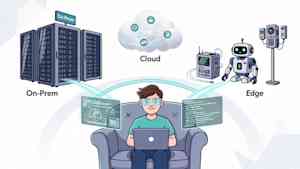
Couchbase announced the AI Data Plane, an operational platform providing agent memory, context retrieval, and an MCP server for enterprise AI agents across cloud, on-prem, and edge.
Beyond the Reranker: Do RAG Retrieval Enhancements Help Once a Strong Reranker Is Present?
Researchers investigate whether RAG retrieval enhancements help when a strong reranker is present, finding that only query expansion and a new method called SSCC yield reliable gains on heterogeneous data.
Multimodal and Multiscale Spatial-Temporal Semantic Search and Recommendation with AI Foundation Models
A new framework using LLMs and VLMs, featuring CAMERA and ASTRA algorithms, is proposed for multimodal spatial-temporal semantic search in Geographic Information Retrieval.
Conversational Query Engine for Mixed-Modality Heterogeneous Enterprise Data Sources
COGNI is introduced as a conversational BI system for heterogeneous enterprise data, utilizing slide-adaptive chunking and a LoRA fine-tuned Qwen model for modality routing.
Model Merging to Evolution: Parameter Space Exploration for Expert Models
The MERGEvolve framework is proposed to improve expert model merging by combining it with an evolution strategy to explore parameter space beyond convex combinations.
When Does Overlap Help? OSU-Mem and a Cell-Conditional Analysis of Trajectory Memory for LLM Agents
The OSU-Mem system analyzes trajectory memory for LLM agents, demonstrating that overlapping semantic units improve retrieval when evidence steps share tool calls or entities.
Memory-Augmented LSTM Autoencoder for Unsupervised Activity Recognition with IMU Sensor Fusion
A memory-augmented LSTM autoencoder is proposed for unsupervised activity recognition using IMU sensor fusion, achieving high accuracy in real-world activity transitions.
LEDGER: Scaling Agentic Document Editing with Dependency-aware Graph Retrieval
LEDGER is introduced to scale agentic document editing by using dependency-aware graph retrieval to maintain consistency and reduce token usage in long structured documents.
HMARS: A Hierarchical Multi-Agent Memory System for Long-Context Reasoning
HMARS is a hierarchical multi-agent memory system designed to improve long-context reasoning by treating long contexts as managed memory instead of a flat retrieval corpus.
From Regulatory Approvals to Patents: Cross-Domain Linking for Cardiovascular Device Traceability
Bridge-MedDevKG is a framework that links FDA-approved medical devices to their patents using a domain-specific ontology and multi-signal candidate generation.
SafeGEO: Understanding Generative Engine Optimization Risks in Recommendation Agents
The SafeGEO evaluation suite analyzes risks where content owners manipulate web content to unfairly increase product visibility in recommendation agents.
ReasonRec: A Reasoning-Augmented Multimodal Agent for Unified Recommendation
ReasonRec is a reasoning-augmented multimodal agent that uses visual instruction tuning and uncertainty-guided delegation to improve recommendation accuracy and efficiency.
How Do LLMs Cite? A Mechanistic Interpretation of Attribution in Retrieval-Augmented Generation
A mechanistic study of Llama-3.1-8B-Instruct reveals that LLM citations in RAG are produced by a distributed 'attributional ensemble' rather than a single localized component.
Carolina Guide: A Multi-Agent RAG System with Institutional Guardrails for Academic Policy Assistance
Carolina Guide is a multi-agent RAG system developed for academic policy assistance at the University of South Carolina, prioritizing safety and institutional guardrails.
ConCise: Training-Free Conclusion-Chain State Compression for Cost-Efficient Multi-Step RAG Services
ConCise is a training-free protocol that reduces token consumption in multi-step RAG services from O(N^2) to O(N) by using a chain of structured conclusions.
LUMEN: Cost-Transparent Multi-Agent Pipeline for Automated Systematic Review and Meta-Analysis
LUMEN is an open-source multi-agent pipeline for automating systematic reviews and meta-analyses, providing a first empirical characterization of its operational costs.
meta-pipe: An LLM-agent pipeline for end-to-end automated systematic review and meta-analysis
meta-pipe is an open-source LLM-agent pipeline for end-to-end automated systematic review and meta-analysis, featuring mandatory human oversight.
CAMI: Cost-Aware Agent-Guided Multi-Indexing for Semantic Retrieval
CAMI is a cost-aware multi-indexing framework that optimizes the selection of semantic enrichment indices for RAG to maximize retrieval recall under a budget.